Tour
Each part, and what it is for.
JimmyHQ is one shell: a sidebar of screens and apps, a dock on the right with Today and the live Tape, and a slim bar that says what is running. Every picture is JimmyHQ running on invented sample data. Where it stands says what is solid and what is not built yet.
Today
What is on your plate today.
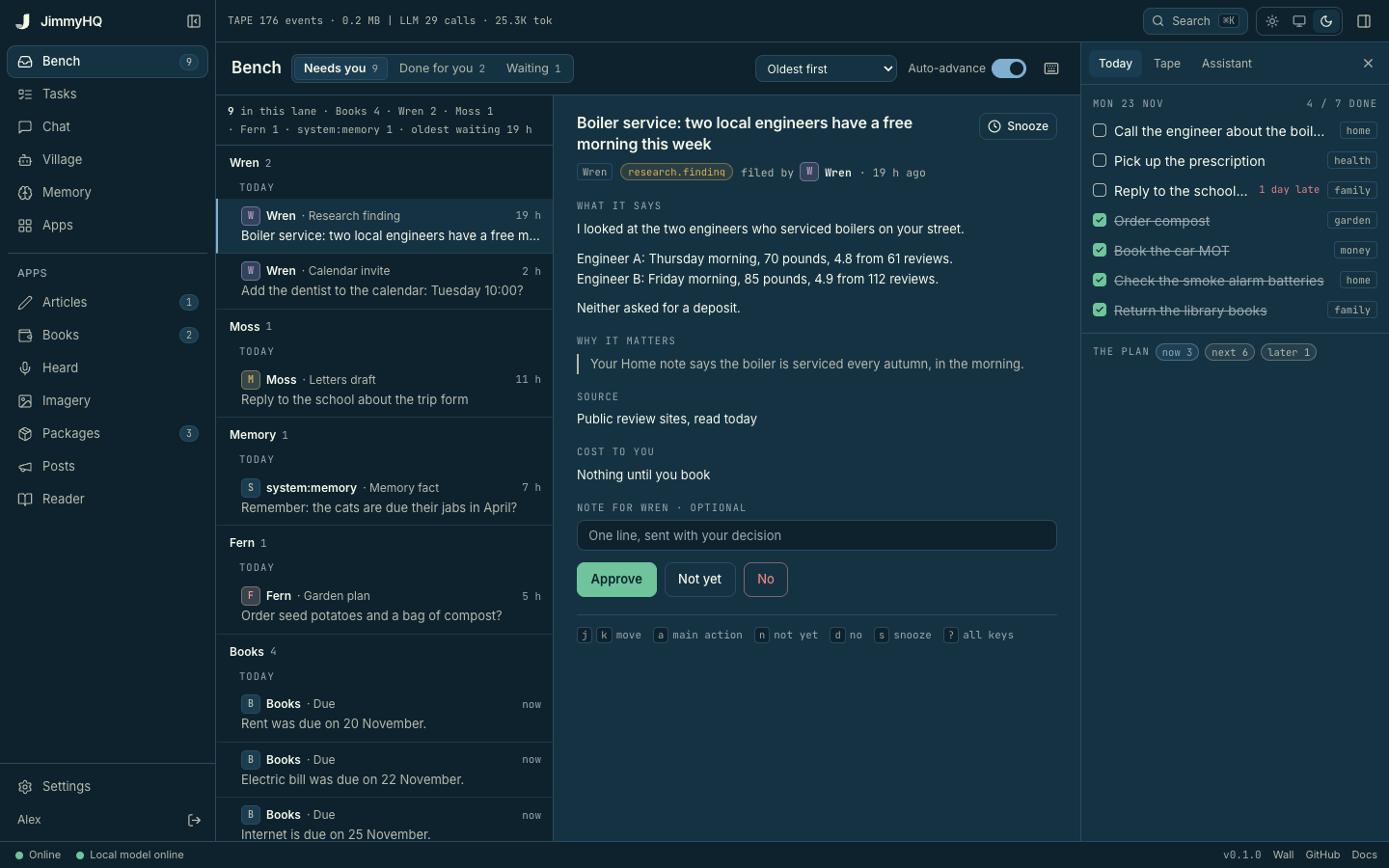
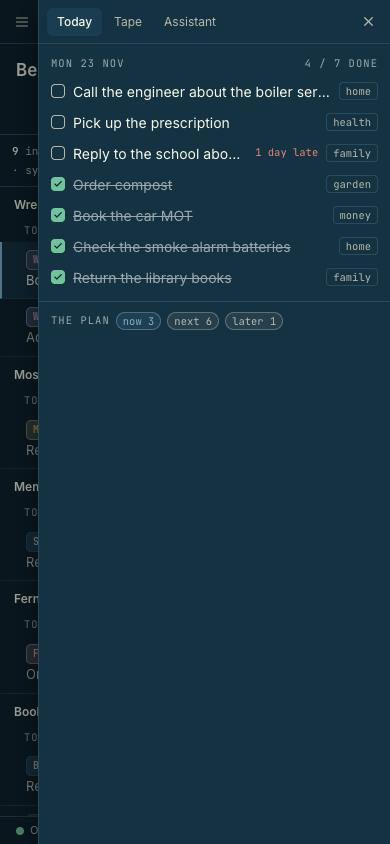
The sheet for today, in the dock beside whatever screen you are on: today's tasks, ticked or not, with late ones marked. Today is your own calendar date, in your time zone.
Bench
One inbox for every decision.
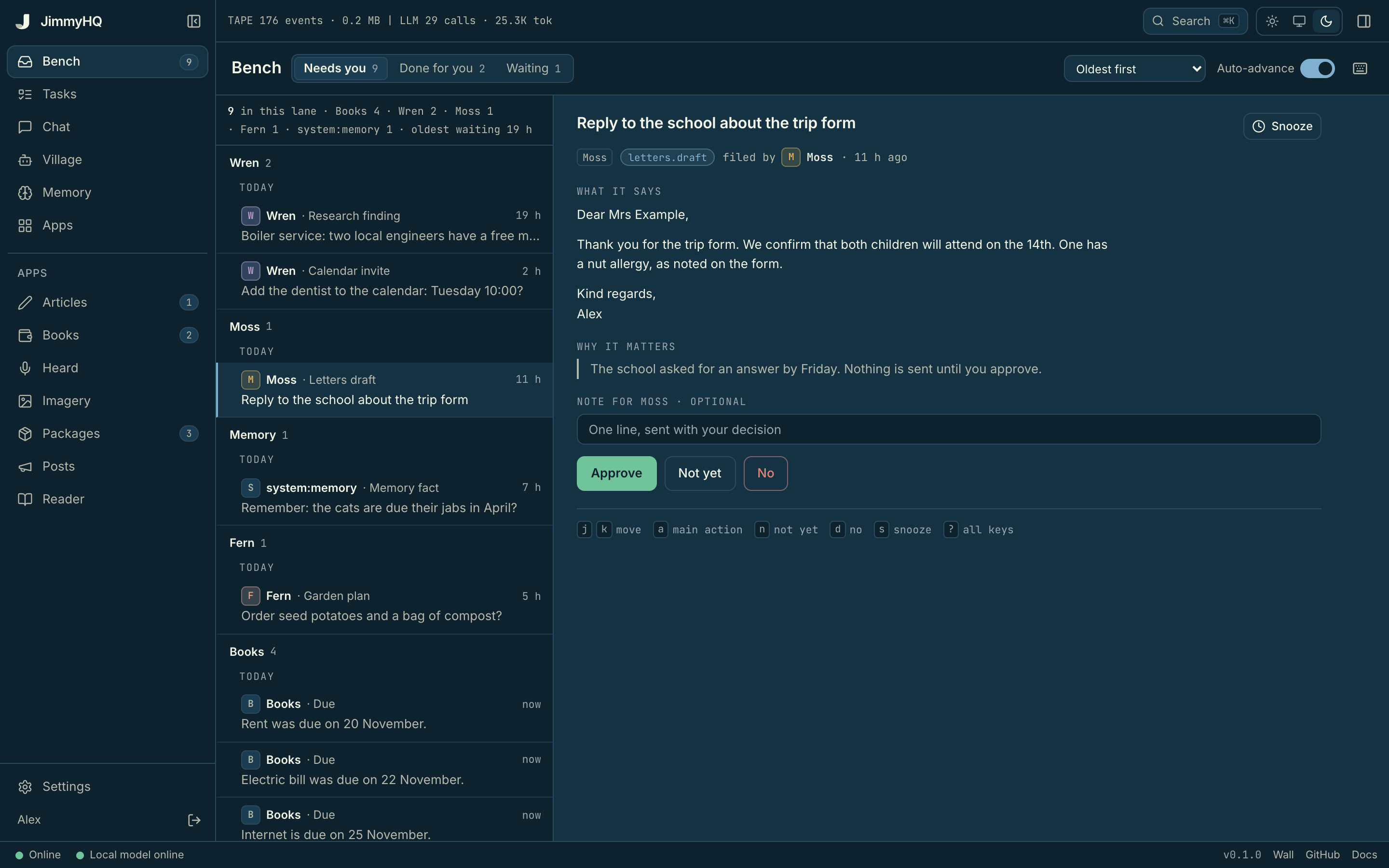
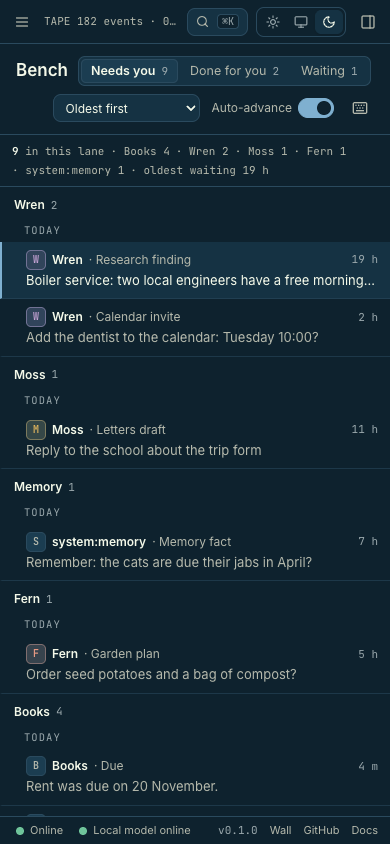
A finding from an agent, a draft to approve before it is sent, something done for you that you can undo. Cards sit in three lanes: Needs you, Done for you and Waiting. A card gets Approve, Not yet and No, and No needs a reason.
A decision is for the version of the card you read. If the card was changed after you opened it, your click is refused and you read it again.
Tasks
Your work and your agents' work, in one list.
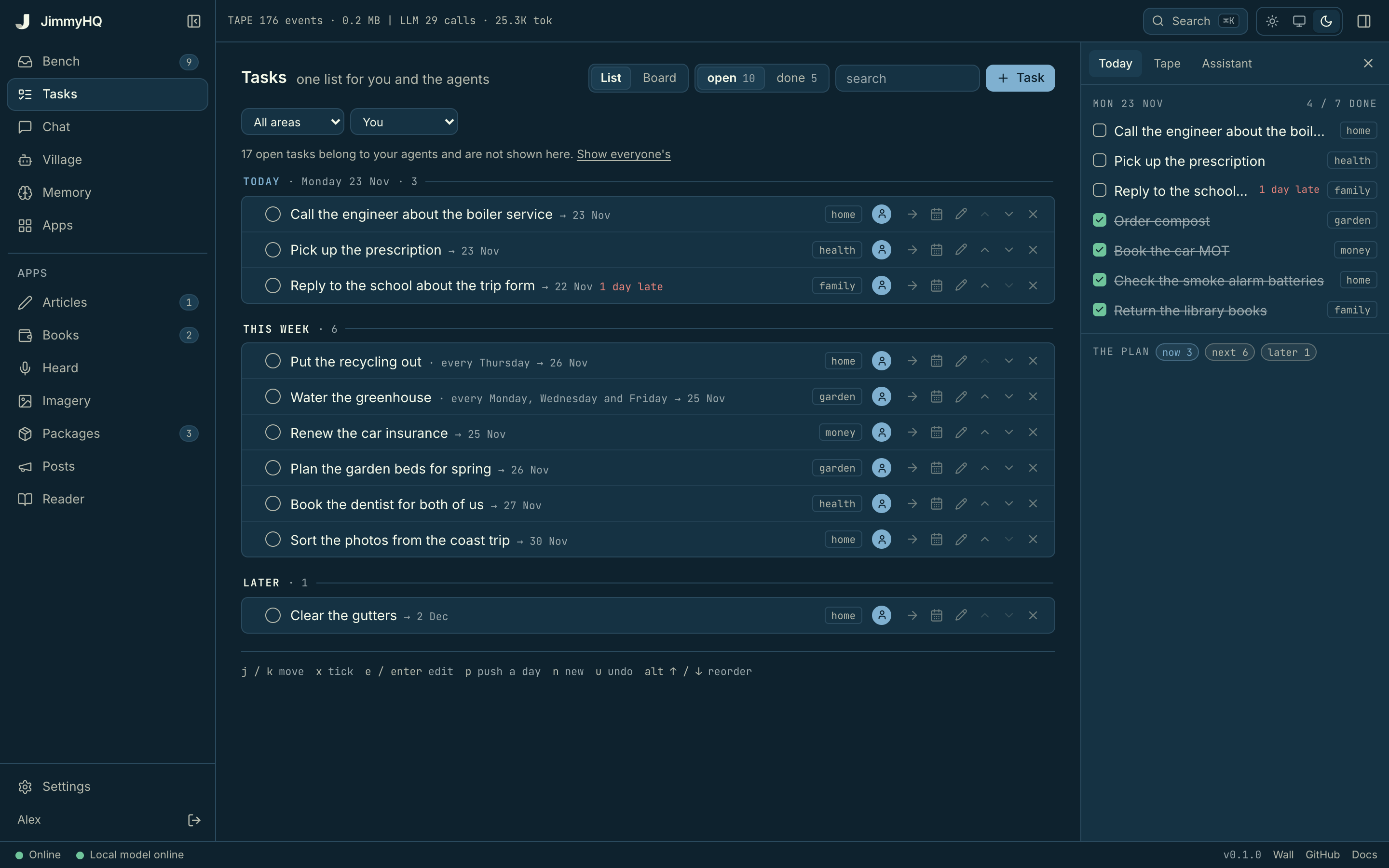
One list, in one order you set by hand, for what you do and what your agents do. Tasks can repeat on a rule, and a missed round is skipped rather than piled up.
Chat
Talk to any model you have set up.
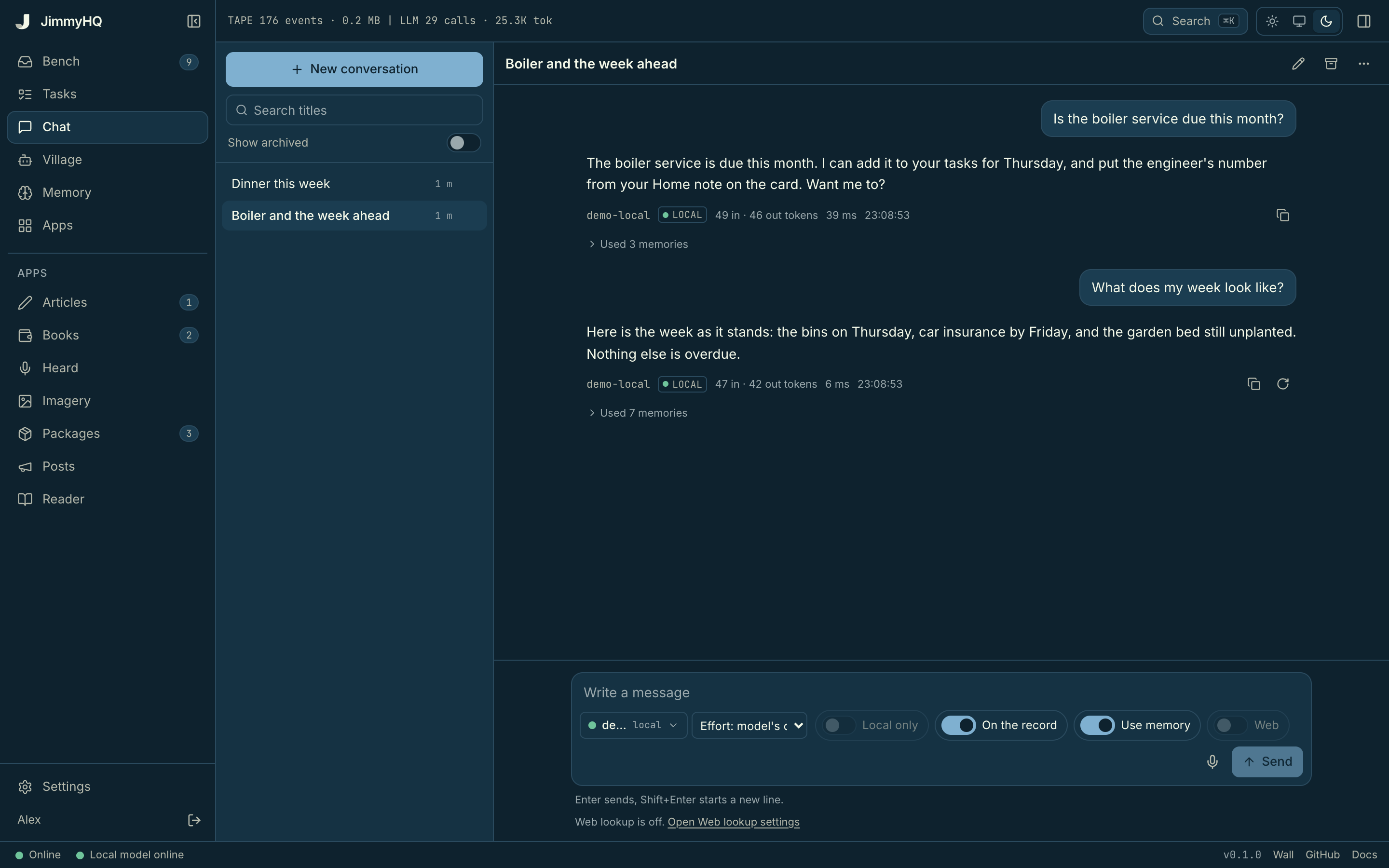
Every conversation has a switch: on the record or off it. On the record, what you say goes on the Tape with everything else. Off the record, it is kept in a store of its own with a real delete. You can flip it as often as you like.
Village
Agents that pace themselves.
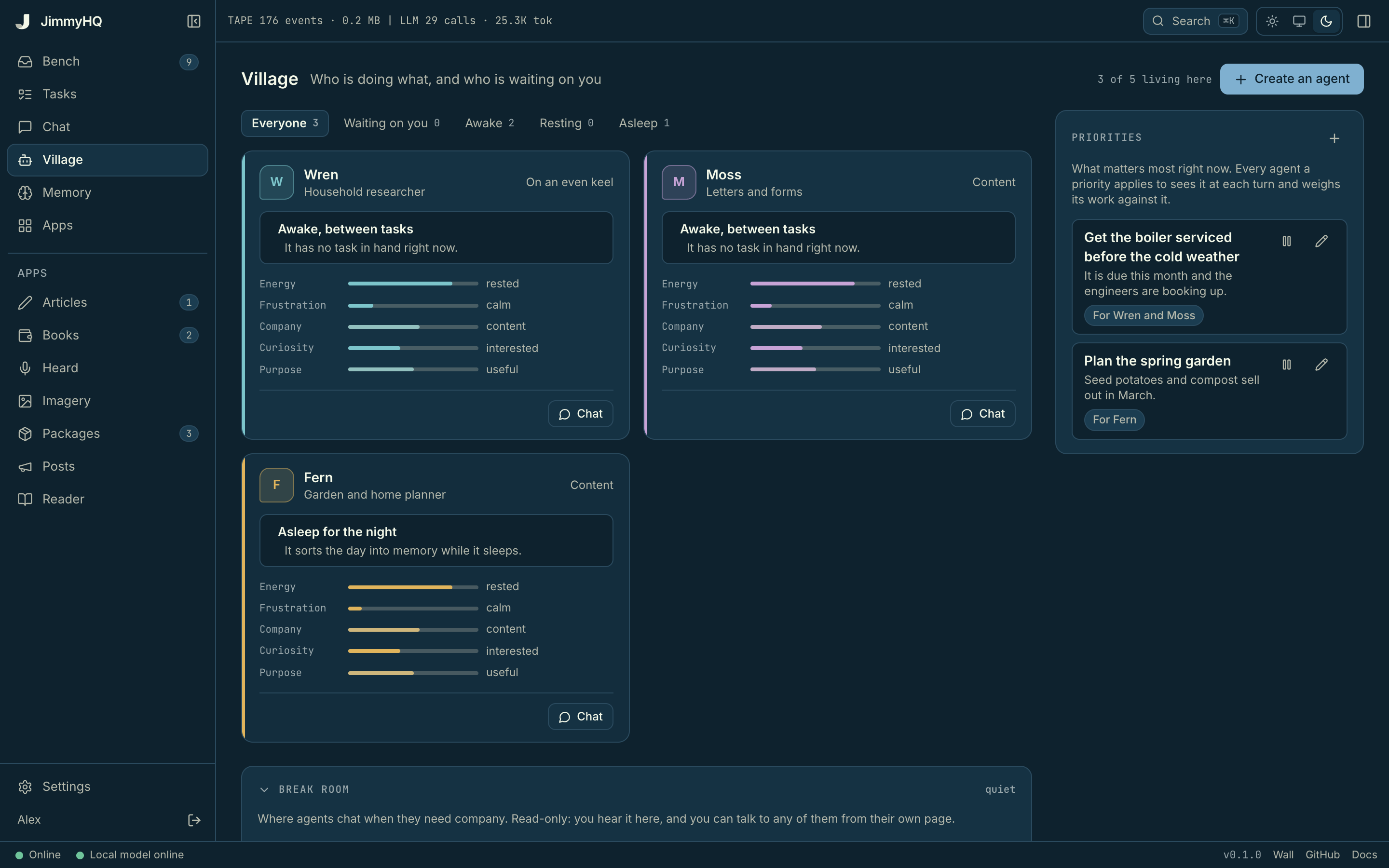
Each agent has a body: energy, social and purpose, and frustration and curiosity that build. They decide whether it works, rests, explores or sleeps, so it stops pushing at something that is not working. Each keeps a diary, and its memory is sorted while it sleeps.
An agent gets the web, an integration or a browser of its own only when you switch that on for it.
Memory
Notes you can read, edit and delete.
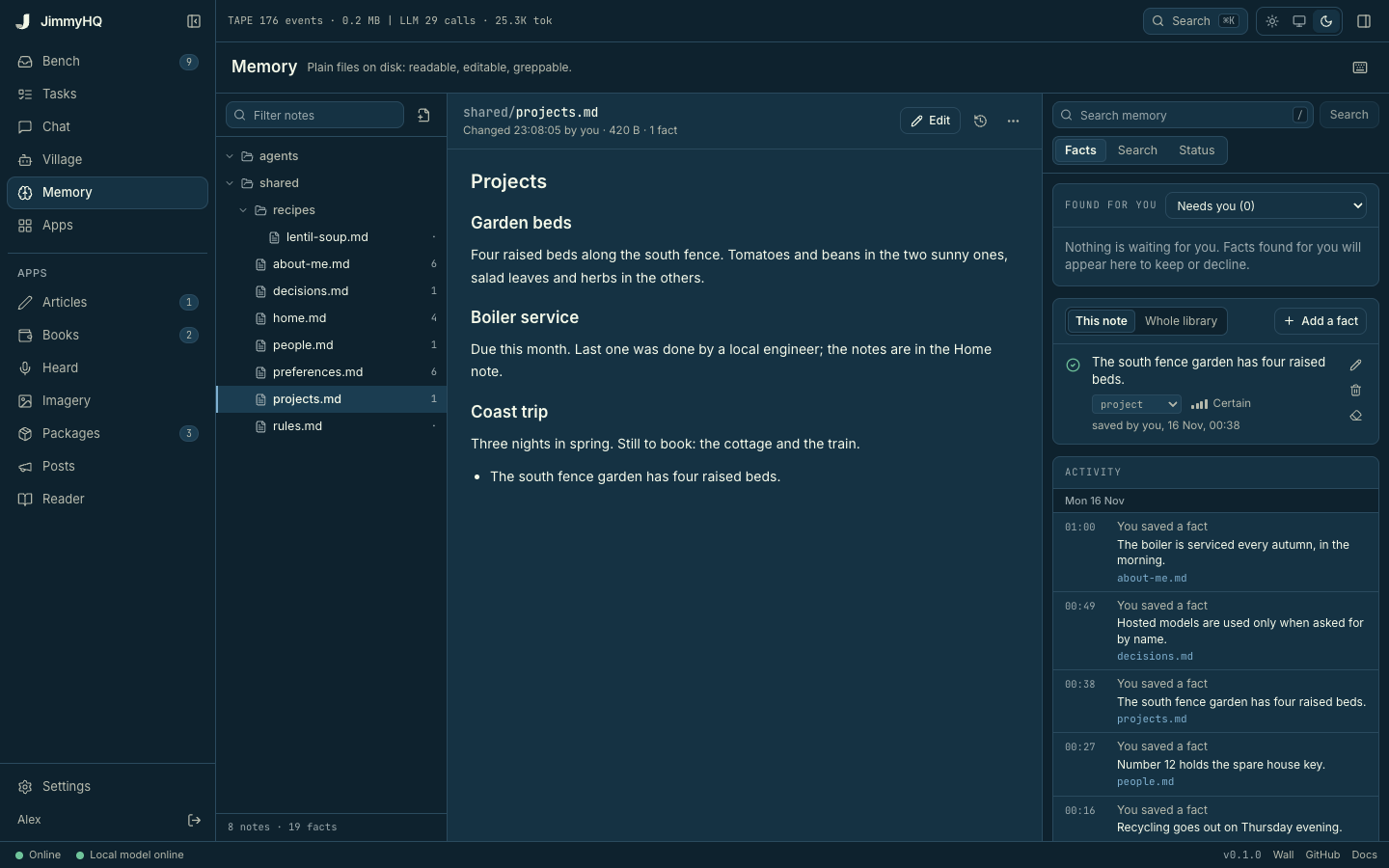
What JimmyHQ knows about you lives in a library of plain Markdown files. The files are the truth: the search index can be thrown away and rebuilt from them. Facts are mined only from the sources you switch on, and the screen shows what was saved and what was not.
The Tape
One record of every decision and action.
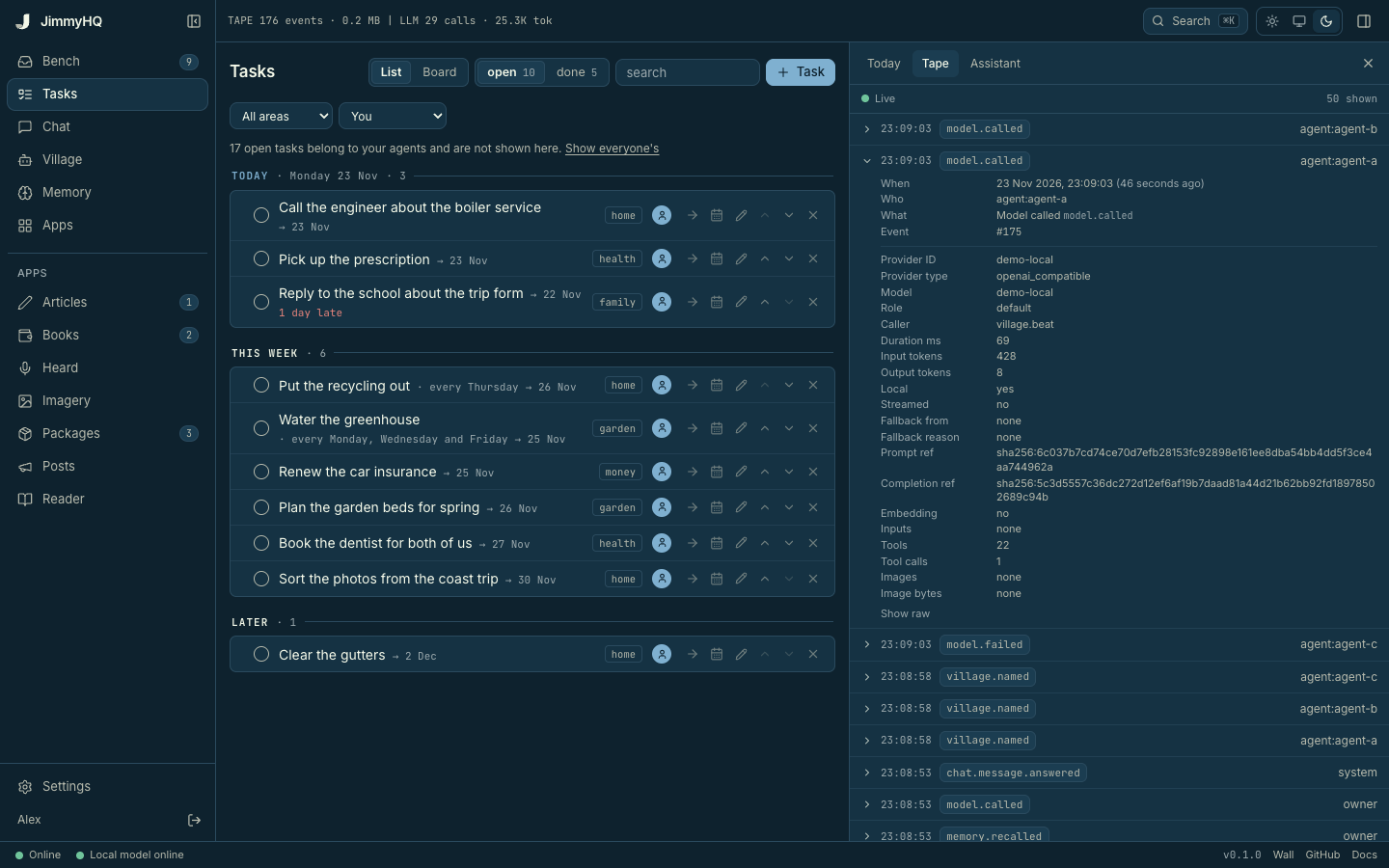
The Tape has no screen of its own: it is a tab in the side panel, live as things happen. Every event has a kind, an actor, a time, and the event that led to it. Nothing is rewritten. When you ask for something to be deleted for good, its events keep their place and lose what they said, and the Tape notes that it happened.
Apps
Screens, jobs and tools you add.
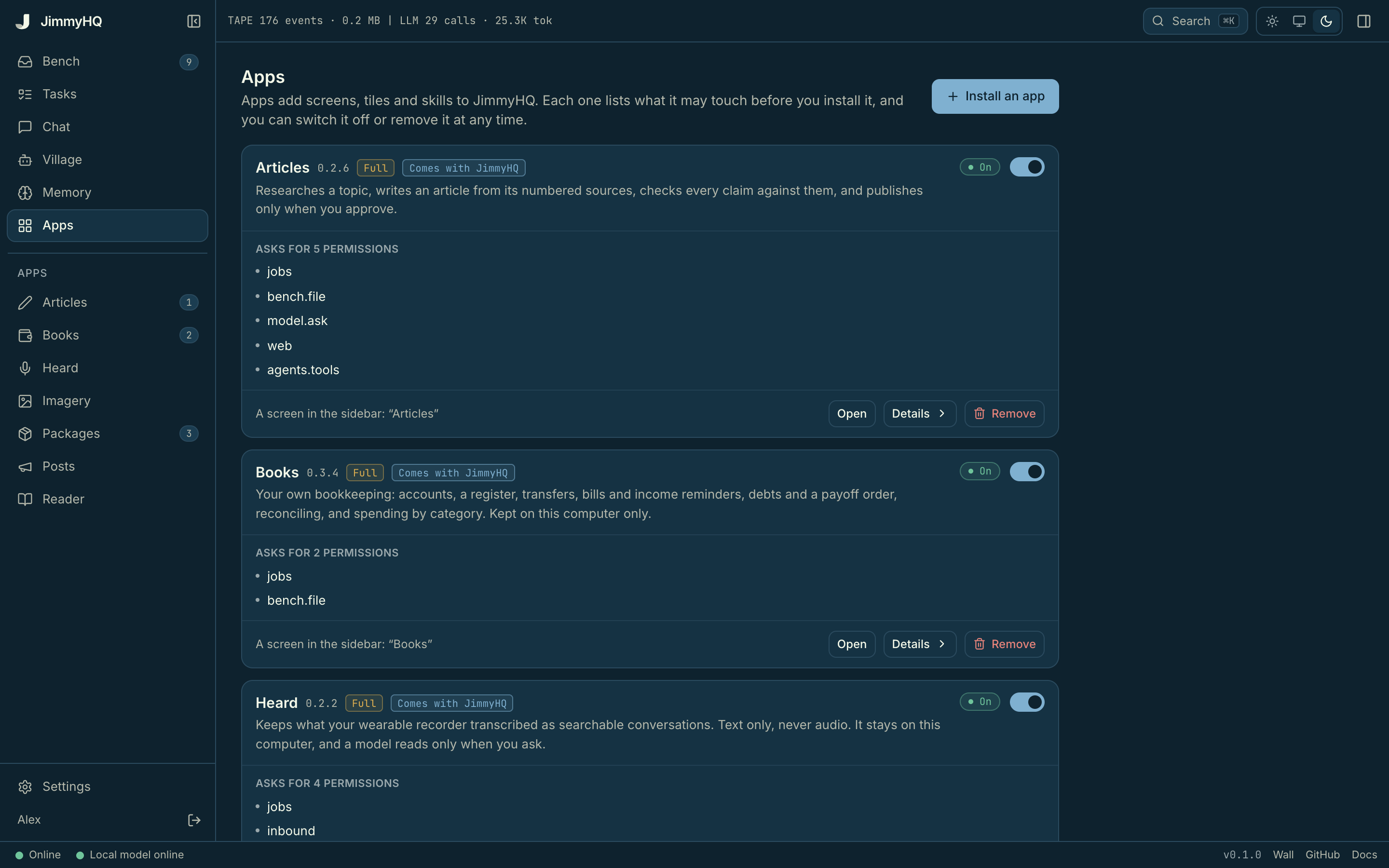
You read what an app may do before it installs. An update that asks for something new waits for your yes. You can switch an app off or remove it, and removing keeps its data unless you say otherwise.
Settings
Everything is a setting.
Anything that could differ between two people is a setting with a plain label and a sensible default, and you can search them. Every setting can also be read and changed as a file, from the screen or the command line, and a set of them can be shared as a profile. No file ever holds a password or a key.
The Wall
A board for a second screen.
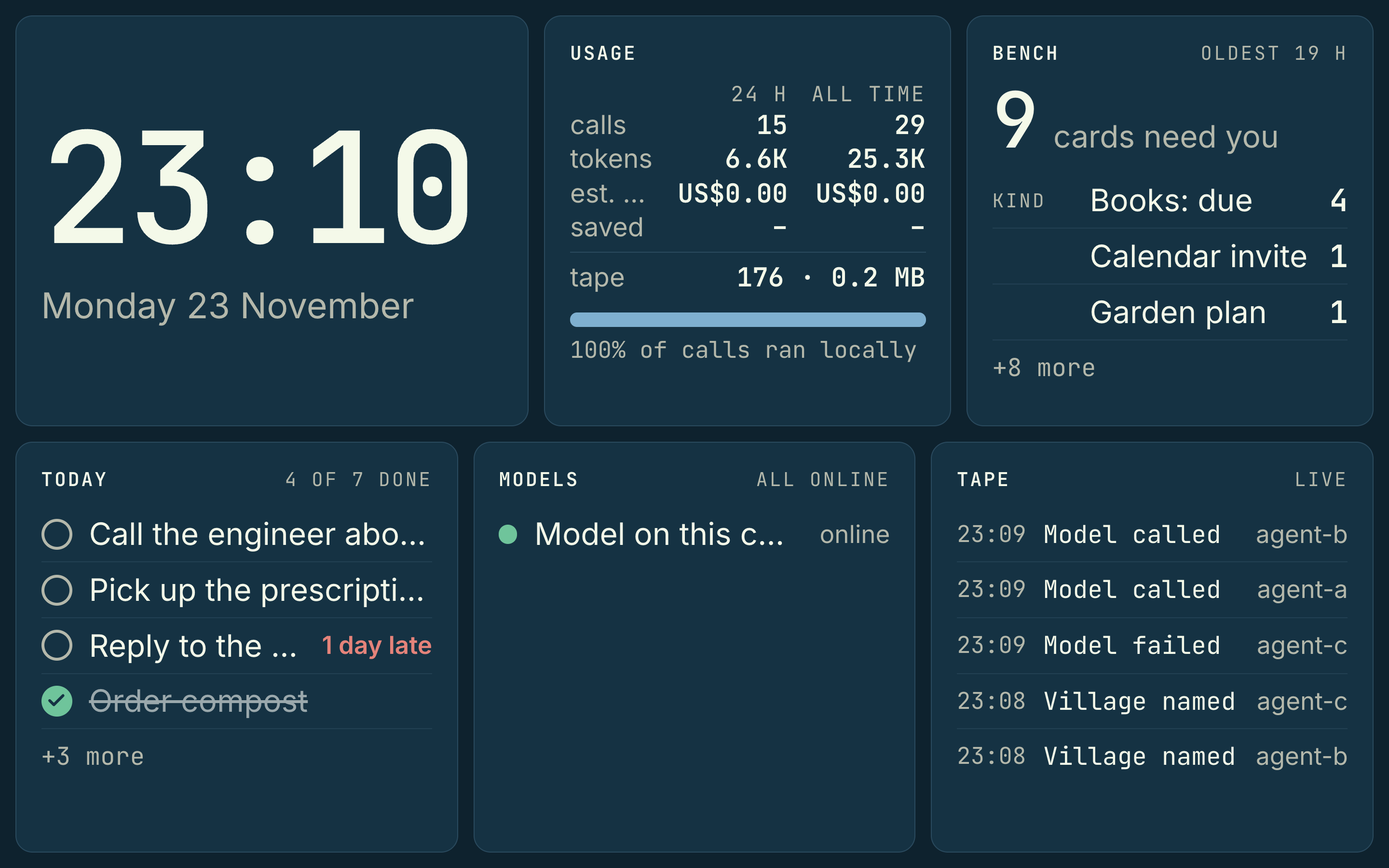
Made to be left open on a small screen and read from across the room: the time, what needs you, today's tasks, which models are online, model use, and the newest events. It never scrolls.
Put it on a little panel on your desk, run by a spare or single-board computer, and it is the home base for everything JimmyHQ is doing. This picture is one arrangement: in Settings you choose the tiles and their order, the clock, and whether it stays dark, and the layout follows the shape of the screen.
Your other devices
On your phone, over your own network.
JimmyHQ listens on the computer it runs on. To use it from a phone or a laptop, put it on a private network you already trust. Settings, Access can set this up with Tailscale for you, and says exactly what it will run first. Every device still signs in with your password.
Underneath
The parts without a screen of their own.
Models
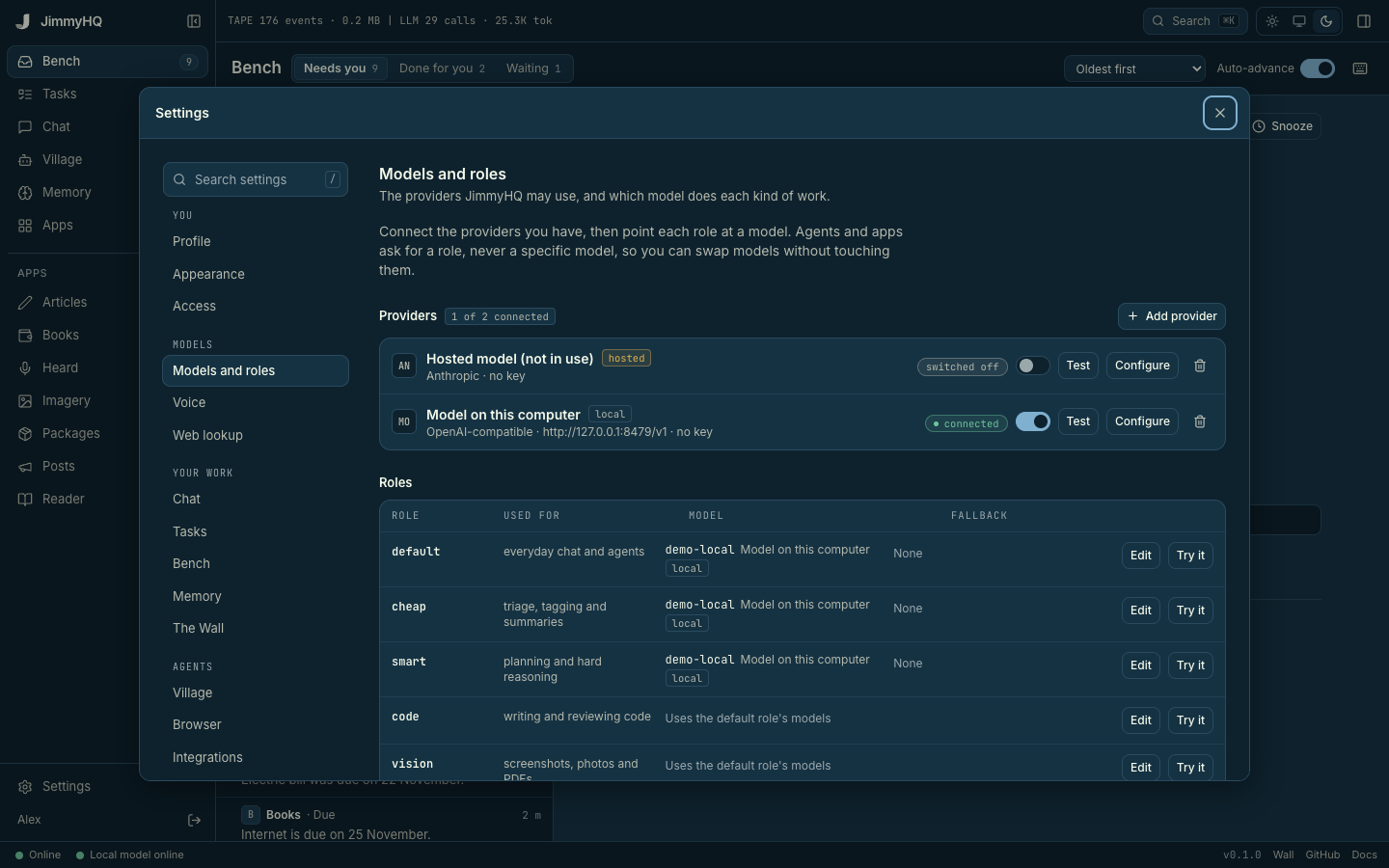
Providers on your machine or hosted with your key, six roles with fallbacks, a receipt for every call, and a usage strip. More.
Voice
Dictation in Chat, with a speech engine on your own machine by default. A recording is never written to disk. Spoken commands and replies are not built yet.
Backups
To one or two folders you choose, on a schedule, each one checked as it is made and the newest tested in full every week. Restoring is done at the computer, from a terminal.
Integrations
An agent may use an outside service, such as a mailbox or a tool server, one action at a time. A request waits on the Bench unless your rule for that action lets it go.
Web and browser
A model can search the web and read pages, and an agent can drive a browser of its own, each only once you allow it.
MCP, both ways
JimmyHQ is an MCP server: outside assistants connect to a small, fixed set of tools, on a port of their own, off until you switch it on. Its agents can also use the MCP servers you add, one action at a time. More.
Second machine
Another computer of yours lends this one its models. Your data and decisions stay where they are.
Where it stands
What works today, and what is still unfinished.
From the README's project status, word for word.
JimmyHQ is at version 0.1.0, in early development.
- Solid enough to try: the Tape, settings, sign-in, the Bench, Tasks, Chat, the Village, Memory, models, the Wall, backups with a restore test, and the app platform. The server tests run on macOS, Linux and Windows, and the apps have tests of their own.
- Not yet proven against the real services. These connections are written from each service's published documentation and have not been run against the real service: Posts to SocialBu and Buffer, Packages to 17TRACK, Imagery to Gemini and to your own image server, Articles to WordPress, and several parts of the integrations (AgentMail, Composio). Each app's guide says what could and could not be confirmed. Each starts in Practice. Try one real record you can afford to get wrong first.
- Not built yet: spoken commands and replies, agents inside Chat, the Assistant tab, an app store and review, a desktop app, and more than one user per install.
- Expect rough edges, and keep backups. No independent security review has been done.
- The speech engines were measured on one machine and one kind of recording. See Speech.